
Table of Contents
UK Business VoIP Reliability: A Guide to Network Sovereignty & Carrier-Grade SLAs
Editorial Insight: In the 2026 UK search landscape, choosing a telephony partner has shifted from a software procurement task to a rigorous infrastructure audit. Most UK enterprises select a provider based on a sleek user interface or aggressive price point, only to discover that their mission-critical voice traffic is being routed through congested, generic public internet pipes. In our experience with UK business networks, the difference between a functional phone system and a business-critical tool is Network Sovereignty.
For the modern CTO, VoIP is no longer just an application layer; it is a connectivity utility that requires the same architectural rigour as a leased line or a primary data centre. Treating voice as “just another app” introduces unacceptable risks regarding latency, jitter, and regulatory compliance. To maintain crystal-clear audio and absolute uptime, scaling firms must partner with a managed VoIP provider that prioritizes voice traffic at the carrier interconnect level, rather than the public “Best Effort” internet level.
1. The Physics of a Phone Call: Solving Latency, Jitter, and Packet Loss
When a business experiences “choppy” audio, robotic distortion, or dropped syllables, it is rarely a fault of the endpoint hardware. It is almost exclusively a symptom of “Last Mile” congestion or poor routing logic. Unlike asynchronous data—such as email or web browsing—Voice over IP is a real-time, synchronous stream. If a packet arrives late, it cannot be re-sent; it is simply discarded.
Latency: The “Talk-Over” Effect
Latency is the round-trip time (RTT) for a voice packet to travel from your internal network to the VoIP exchange and back. In professional UK services—particularly Legal and Finance—any latency exceeding 150ms is considered a failure. This delay causes the “talk-over” effect, where participants interrupt one another because the audio signal hasn’t reached them in real-time.
A tier-1 VoIP service manages this by utilizing direct peering. By minimizing the number of autonomous system (AS) hops between your network and the PSTN breakout point, we reduce the physical distance packets must travel. For high-frequency trading environments or emergency services, we target a sub-50ms RTT.
Jitter: The “Robotic” Voice
Jitter is the variance in packet arrival times. If Packet A arrives in 20ms but Packet B arrives in 60ms, the digital “reassembly” in the handset fails. This results in the “robotic” or “underwater” sound. While jitter buffers can mitigate minor fluctuations, they do so by increasing overall latency. The only true solution is Quality of Service (QoS) tagging at the router and switch level. To learn more about implementing these rules, see our VoIP connectivity and QoS guide.
Packet Loss: The “Dropped Syllable”
Packet loss occurs when a network node becomes so congested that it simply drops incoming data. In a carrier-grade environment, voice packets are given “Gold” or “Priority 1” status. Without this, your voice packets are treated the same as a background Windows update or a YouTube stream. Even a 1% packet loss can render a professional call unintelligible.
2. Defining “Tier-1” Sovereignty in the UK Market
In the world of globalised cloud services, “Network Sovereignty” has become the highest-value authority signal for CTOs. Many “off-the-shelf” VoIP apps route traffic to the nearest data centre based on cost, not quality. It is common for a call between London and Birmingham to be routed through a data centre in Frankfurt or Amsterdam because the provider is using a generic AWS or Google Cloud instance with no UK-specific routing logic.
This introduces Geographical Latency. Every time a packet crosses the English Channel, it passes through multiple international exchanges, each adding 10–30ms of delay and increasing the surface area for a potential intercept or outage.
The Stride Sovereign Backbone
True reliability is found in a UK-centric architecture. By utilizing our UK-based VoIP network, your voice traffic remains within sovereign UK borders. Stride operates direct interconnects with the London Internet Exchange (LINX) and LONAP, ensuring that your data takes the shortest path possible. This isn’t just a technical preference; it is a requirement for firms needing to comply with stringent UK data laws and ensure the highest possible Mean Opinion Score (MOS).
3. Regulatory Compliance: Ofcom, GDPR, and the 2027 PSTN Switch-off
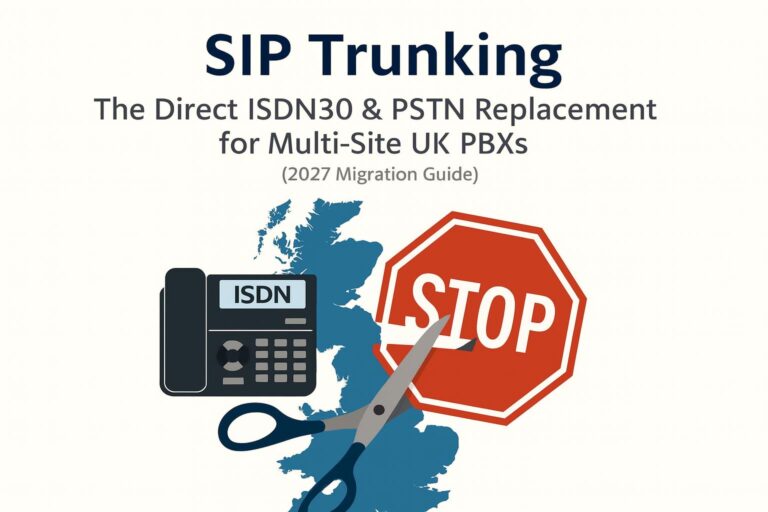
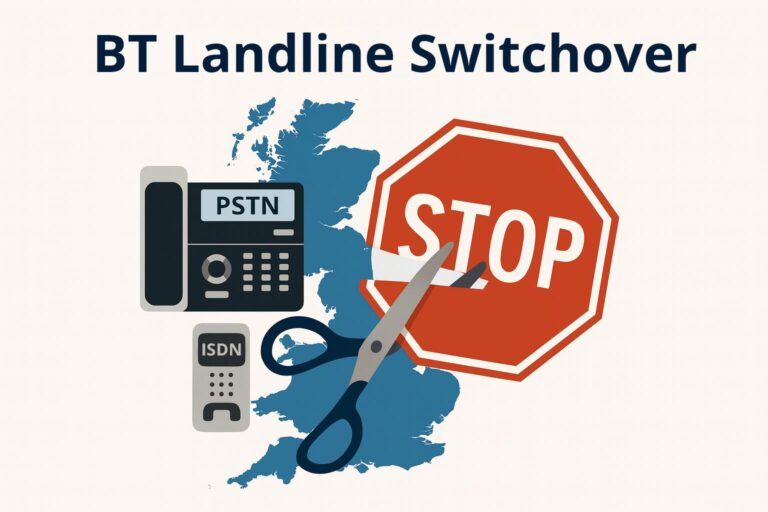
The upcoming 2027 PSTN switch-off is often framed as a hardware problem, but for the CTO, it is a regulatory milestone. As Openreach retires the legacy analogue and ISDN networks, every UK business is moving to an “All-IP” ecosystem. This transition removes the physical security of the copper wire and replaces it with the digital security of the SIP trunk.
The Legal Necessity of Secure SIP (SIPS)
For sectors like Law, Healthcare, and Finance, transmitting voice data in plain text is a compliance breach. Standard VoIP uses SIP on port 5060, which is unencrypted. A managed, carrier-grade provider defaults to Secure SIP (TLS) and SRTP (Secure Real-time Transport Protocol). This ensures that even if a packet is intercepted, the audio content remains encrypted.
Security is not a “bolt-on” feature; it is a foundational element of the network. Reviewing VoIP security and UK compliance protocols is essential for any firm handling sensitive client data. A managed network provides the Secure SIP and TLS encryption required to stay ahead of Ofcom’s evolving General Conditions on security and resilience.
4. The Role of the Session Border Controller (SBC) in High-Availability
To an IT Director, the Session Border Controller (SBC) is the “VoIP Firewall.” Generic providers often hide their SBC architecture, but in a Tier-1 environment, the SBC is the gatekeeper of reliability. It performs three critical functions:
- Protocol Normalization: Ensuring that different SIP “dialects” can communicate seamlessly without dropped calls.
- DoS Mitigation: Protecting the network from SIP-based Distributed Denial of Service attacks that target the telephony system specifically.
- Media Anchoring: Controlling the path of the audio stream to ensure it follows the most efficient route, rather than “hairpinning” through unnecessary nodes.
When you move to a managed VoIP provider, you are gaining access to an enterprise-grade SBC cluster that provides geo-redundancy. If one UK data centre faces an issue, the SBCs automatically re-route traffic to a secondary UK site in milliseconds, often without the user even noticing a click on the line.
5. The Economic Reality: The “Cost of a Dropped Call” Math
While a “budget” VoIP provider might save a firm £500 a year in subscription costs, the “hidden tax” of unreliability is significantly higher. For a professional services firm with 50 staff, one hour of total telephony downtime can be calculated as follows:
- Direct Labour Loss: 50 staff x £40/hr = £2,000
- Opportunity Cost: Average lead value £1,000 x 3 missed calls = £3,000
- Brand Erosion: Difficult to quantify, but translates to higher churn and lower client “Lifetime Value” (LTV).
In this scenario, a single hour of downtime costs the business £5,000. This is why Carrier-Grade SLAs (99.999%) are not a luxury—they are a financial insurance policy. A managed network provides the stability of our UK-based VoIP network, ensuring that the “Utility Backbone” of your business never becomes a point of failure.
6. Infrastructure Audit: A Step-by-Step Framework for IT Leaders
If you are currently evaluating your telephony stack for the 2026/2027 cycle, use this Migration Risk Index to score your current or prospective provider:
| Audit Metric | Managed/Tier-1 (Stride) | Generic/App-Based |
|---|---|---|
| Network Path | Direct Interconnect (UK Sovereign) | Public Internet (Best Effort) |
| SLA Guarantee | 99.999% (Backed by Finance) | 99.0% or None |
| Data Residency | 100% UK (Ofcom/GDPR Ready) | Varies (US/EU/Asia) |
| Support Level | 24/7 UK Engineering NOC | Ticketing/Global Call Centre |
7. Advanced Technical Concepts: Peering vs. Transit
To truly understand UK Business VoIP Reliability, one must distinguish between IP Transit and Peering. Most VoIP providers buy “Transit”—they pay a third-party ISP to carry their data. The problem is that the Transit provider will route that data over the cheapest possible path, regardless of latency.
A tier-1 VoIP service utilizes Peering. This means we have direct physical connections with major UK ISPs like BT, Virgin Media, and Sky. When a user on a BT line calls a user on the Stride network, the data never touches the “public” internet; it stays on a private, high-speed exchange. This is the gold standard for voice reliability.
8. Technical FAQ: VoIP Reliability & Infrastructure
What is the difference between Public and Private Peering for VoIP?
Public peering occurs at an Internet Exchange (IX) where multiple networks exchange traffic over a shared fabric. Private peering (P-NNI) is a dedicated physical link between Stride and an ISP. Private peering is superior as it eliminates the congestion found on public fabric, providing a dedicated "HOV lane" for your voice traffic.
Why is the PSTN 2027 switch-off relevant to network reliability?
Legacy PSTN was inherently reliable because it was a circuit-switched network with its own power supply. VoIP is packet-switched. To achieve PSTN-level reliability, you must implement power redundancies (UPS) and network redundancies (Dual WAN with failover) to replace the "always-on" nature of legacy copper lines.
What is a "Mean Opinion Score" (MOS), and why should I care?
MOS is a numerical measure (1-5) of the perceived human quality of a voice call. A carrier-grade network should consistently deliver a MOS of 4.2 or higher. Budget providers often dip into the 3.0 range, which results in user complaints about "distance" or "echo."
How does SD-WAN affect VoIP reliability?
SD-WAN allows for real-time path selection. If your primary fibre line experiences 5% packet loss, the SD-WAN can move the voice stream to a secondary line (e.g., 5G or a secondary ISP) packet-by-packet without dropping the call. It is the ultimate tool for 100% uptime in a managed environment.
Is SIP Trunking more reliable than a Hosted Cloud Phone System?
Both utilize the same underlying SIP technology. However, SIP Trunking is often preferred by larger enterprises because it allows them to maintain control over their internal hardware (PBX) while outsourcing the "external" network reliability to a managed provider like Stride.
Does encryption (TLS/SRTP) increase latency?
While the act of encrypting and decrypting packets does require CPU cycles, modern Session Border Controllers and handsets handle this in microseconds. The latency added by encryption is negligible (sub-1ms) and is a mandatory trade-off for security compliance.
9. Conclusion: The Utility of Voice
As we approach 2027, the gap between "standard" VoIP and "Carrier-Grade" infrastructure will continue to widen. For the CTO, the goal is simple: ensure that the phone system is so reliable it becomes invisible. When you focus on network sovereignty, direct peering, and technical QoS, you move from "Software VoIP" to "Infrastructure VoIP."
Don't settle for "good enough" connectivity that views your voice traffic as just another data packet. Move your business to our UK-based VoIP network and experience the stability of a managed, sovereign utility backbone.
Ready to Future-Proof Your Network?
Schedule a 15-minute Technical Infrastructure Review with our UK NOC team today.
Audit My VoIP Infrastructure →About the Author
Written by: Bhav | Telecommunications Infrastructure & Migration Specialist
Bhav is a veteran of the UK telecoms landscape with over 15 years of hands-on industry experience, specializing in the intersection of Layer 2/3 network architecture and unified communications. With a deep technical background in ISDN PRI environments and multi-site IP-PBX deployments, he has spent more than a decade engineering high‑availability voice networks for enterprise and carrier-grade environments. Bhav is a leading voice on the 2027 PSTN migration, helping UK businesses transition from legacy copper infrastructure to modern, “Voice‑First” fibre‑optic ecosystems.
Article Freshness & Accuracy
Last Updated: January 26, 2026
Fact-Checked by: Stride Technical Engineering Team
Compliance: This guide is reviewed quarterly to align with the latest Openreach "Stop Sell" exchange updates, Ofcom General Conditions, and UK sovereign data residency standards.