Table of Contents
Understanding ISDN: From Digital Pioneer to the 2027 Retirement
The 31 January 2027 ISDN switch-off is the most significant technical migration in UK history. While ISDN provided reliable 64 kbps digital voice for decades, its aging copper architecture is now a critical bottleneck for modern cloud-driven businesses.
Book your free ISDN Migration Audit today →
1. Introduction: The Bridge to the Digital Age
The Integrated Services Digital Network (ISDN) was the technology that first proved voice, video, and data could coexist on a single copper line. Introduced to the UK market in the late 1980s and popularized in the 90s, ISDN saved businesses from the “one line, one task” limitation of the analog PSTN. Before ISDN, if a member of staff was using the fax machine, the telephone line was physically occupied and unreachable.
ISDN digitised the “last mile,” allowing digital signals to travel over the existing copper pairs managed by Openreach. However, the world has transitioned from simple 64 kbps voice calls to gigabit-speed cloud environments and HD video conferencing. The very architecture that made ISDN stable—its rigid, fixed-channel design—is exactly why it is now failing to meet modern business demands. Stride Communications specializes in de-risking this transition, ensuring that the move from legacy digital circuits to modern IP telephony is seamless and commercially advantageous.
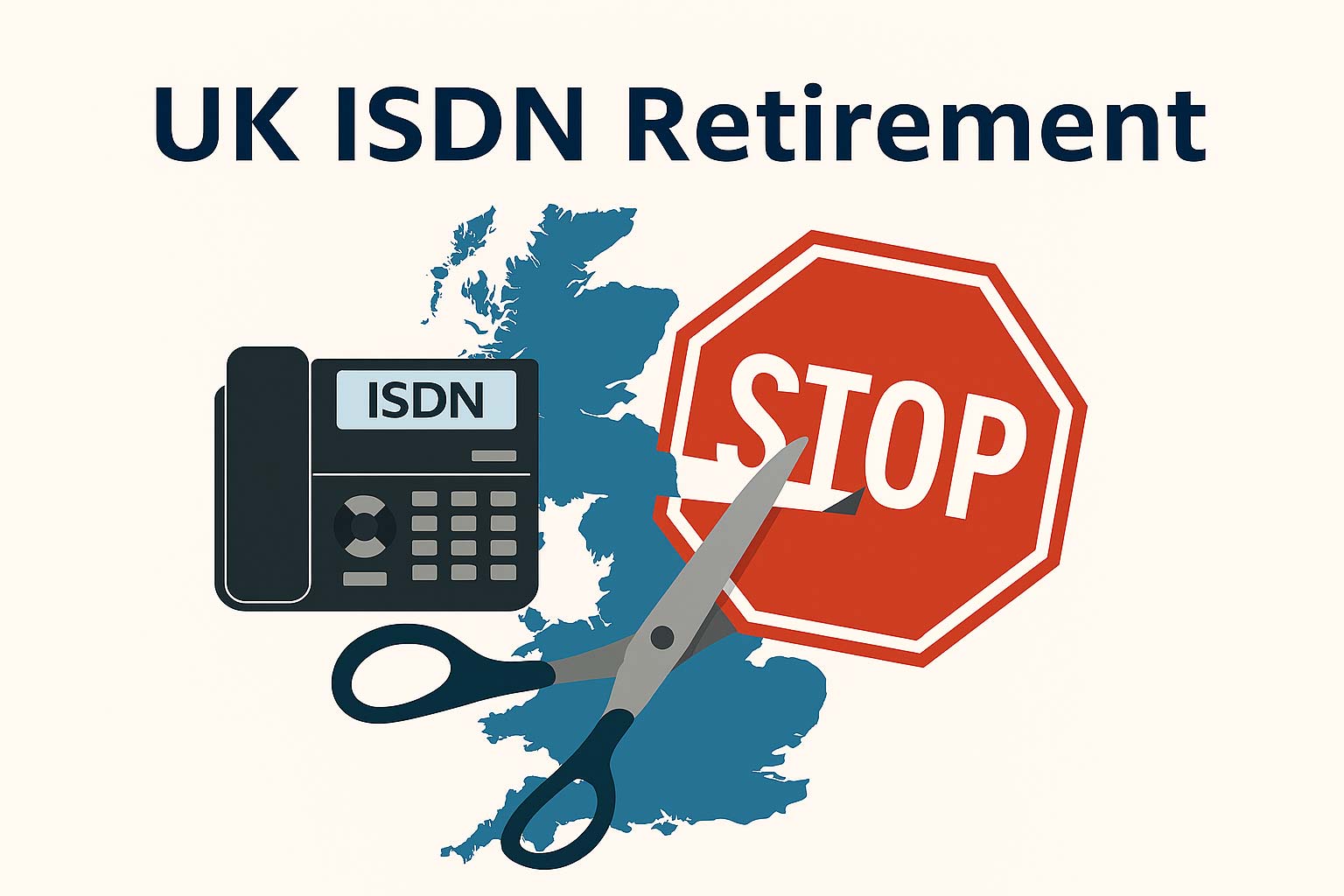
The Hard Stop: 31 January 2027 is the final deadline. After this date, all ISDN2e and ISDN30 services in the UK will be permanently terminated. Stride Communications is helping businesses navigate this transition to ensure no loss of service during the national “All-IP” migration.
2. The Anatomy of an ISDN Line: B and D Channels
To understand why ISDN is reaching its technical limit, we must examine the specific “bits and bytes” of its architecture. Unlike analog lines, ISDN uses time-division multiplexing to split a wire into distinct logical pathways.
The Bearer (B) Channel: The Payload
The B-channel is the primary workhorse of the ISDN system. It carries the actual “user data,” whether that is a voice conversation or a digital data transfer.
Technical Specification: Each B-channel operates at a fixed rate of 64 kbps.
Circuit-Switched Logic: When a call is placed, the network reserves a dedicated 64 kbps path. This bandwidth is occupied for the duration of the call, even during moments of silence.
The Delta (D) Channel: The Control Room
The D-channel is the signaling pathway. While the B-channel handles the “media,” the D-channel handles the “instructions.”
Signaling Protocol: The D-channel uses the Digital Subscriber Signalling System No. 1 (DSS1) protocol to talk to the exchange.
Out-of-Band Efficiency: Because the signaling (call setup, caller ID, and hang-up signals) happens on the D-channel, it does not interfere with the voice quality of the B-channels.
3. UK Standards: ISDN2e (BRI) vs. ISDN30 (PRI)
In the UK, ISDN is delivered in two primary formats tailored to different business sizes. Stride Communications frequently audits these legacy lines to help clients understand their current capacity and how it translates to SIP requirements.
ISDN2e (Basic Rate Interface – BRI)
Typically used by small offices, retail outlets, and for early-stage home internet.
Structure: Consists of 2 B-channels and 1 D-channel (2B+D).
Use Case: Allows for two simultaneous calls or one call and one digital payment terminal (EPOS) connection.
The S0 Interface: Delivered via a standard RJ45 socket, ISDN2e lines can be bonded together to increase channel counts in increments of two.
ISDN30 (Primary Rate Interface – PRI)
The enterprise-grade standard designed for on-premise PBX systems.
Structure: In the UK, we follow the E1 standard, providing up to 30 B-channels and 1 D-channel.
E1 vs T1: While the US uses the T1 standard (23 channels), the UK E1 standard offers a full 2.048 Mbps of bandwidth, supporting 30 high-quality concurrent voice calls.
DDI Integration: ISDN30 allowed businesses to assign hundreds of Direct Dial In (DDI) numbers to a small number of physical channels.
4. Why ISDN Won the 90s (And Why It Is Losing Now)
ISDN was the premier choice because it offered a “Clear Channel” advantage. Analog lines suffered from static, echoes, and signal drop-off due to distance. Because ISDN was digital, the voice quality remained consistent as long as the connection was maintained. This reliability allowed businesses to grow with confidence, but that confidence is now misplaced as we approach the 2027 sunset.
The Internet Revolution
Before ADSL or Fiber became common, ISDN “Bonding” was the fastest way to get online. By combining two 64 kbps channels, businesses achieved 128 kbps—the “superfast” internet of its day. This enabled the first wave of remote server access and digital file sharing, laying the groundwork for the cloud-based world we operate in today.
The 64 kbps Bottleneck
In 2026 and 2027, 64 kbps is a technical liability. Modern communications require:
HD Voice (G.722): Requires more than 64 kbps for wideband audio.
- Video Conferencing: A standard 720p video call requires 1,500 kbps (1.5 Mbps).
ISDN’s rigid architecture cannot support the dynamic bandwidth requirements of a modern hybrid workforce. Stride Communications helps you bridge this gap by transitioning to high-bandwidth IP solutions.
5. Proprietary Insight: The Stride Communications “Migration Risk Index”
At Stride Communications, we utilize a proprietary Migration Risk Index (MRI) to evaluate how vulnerable a business is to the 2027 switch-off.
Level 1 (Low Risk): Business uses ISDN solely for voice with a modern IP-ready PBX.
Level 2 (Medium Risk): Business relies on ISDN for “silent services” like lift phones, security alarms, or older PDQ machines.
Level 3 (High Risk): Business uses legacy on-premise hardware with no spare “line cards” available and has more than 50 DDI numbers that require complex porting.
Get your Migration Risk Score today →
6. The “Silent” Risks of the 2027 Switch-Off
The move away from ISDN is driven by physical infrastructure failure, not just a desire for newer software. As we move closer to the date, the cost of inaction increases.
Maintenance Scarcity
Openreach engineers are no longer being trained on legacy ISDN hardware. As the “Silver Tsunami” of veteran engineers retires, the tribal knowledge required to maintain DSS1 protocols and System X exchanges is vanishing. If your legacy hardware fails in 2026, the wait time for a specialist repair could be weeks.
The “Stop Sell” Reality
As of September 2023, a national “Stop Sell” is in effect. You cannot order new ISDN lines or expand your current ISDN30 capacity. Businesses are currently operating on “frozen” technology; if your business grows, ISDN cannot grow with you. Stride Communications offers the scalability that legacy digital circuits lack.
Hardware Fragility
Legacy PBX systems rely on physical “Line Cards” to interface with ISDN. These cards are no longer manufactured. If a power surge destroys your ISDN gateway, your only option may be to source a 20-year-old refurbished part from eBay—a significant risk to business continuity.
7. Comparison: PSTN vs. ISDN vs. VoIP
| Feature | PSTN (Analog) | ISDN (Digital) | VoIP (Cloud) |
| Technology | Analog Circuit-Switched | Digital Circuit-Switched | IP Packet-Switched |
| Primary Medium | Copper | Copper (Digital) | Fiber / 5G / Ethernet |
| Channel Capacity | 1 Channel | 2 to 30 Channels | Virtually Unlimited |
| Voice Quality | Standard | Clear (Digital) | High Definition (HD) |
| Flexibility | Fixed Location | Fixed Location | Work from Anywhere |
| Maintenance | High (Obsolete) | High (Specialist Required) | Low (Cloud-Managed) |
| UK Status | Retiring Jan 2027 | Retiring Jan 2027 | Future Standard |
8. The Migration Path: SIP Trunking vs. Hosted VoIP
Stride Communications provides two primary technical pathways for businesses leaving ISDN. The choice depends on your current infrastructure and long-term business goals.
SIP Trunking: The Intermediate Bridge
If your business has a modern on-premise PBX that is IP-compatible, you can utilize SIP Trunking. We replace the physical ISDN cable with a virtual “trunk” over your internet connection. This allows you to keep your existing hardware while benefiting from lower costs and the flexibility of the cloud.
Explore SIP Trunking Options →
Hosted VoIP (Cloud PBX): The Total Transformation
For most UK businesses, Hosted VoIP is the most efficient choice. This removes all physical line constraints. Your phone system lives in a secure data center, and employees can take calls on desk phones, laptops, or mobile apps. Stride Communications ensures your network is optimized for this cloud-first approach.
9. Illustrative Proof: The Mid-Sized Manufacturing Migration
An illustrative example of our work involves a UK-based manufacturing firm with 40 staff across two sites. They were utilizing two ISDN30 circuits connected to a 15-year-old PBX. The hardware was failing, and they could no longer find spare parts. Stride Communications performed a full DDI audit and migrated the firm to a 3CX Hosted solution.
By removing the £400 per month ISDN line rental and replacing it with a scalable cloud-based seat model, the firm reduced their annual communications spend by 35% while enabling a “Work from Anywhere” policy that improved staff retention.
10. Conclusion: Don’t Wait for the Resource Crunch
As the January 2027 deadline approaches, the UK will face a massive shortage of telecoms engineers. Thousands of businesses will attempt to migrate simultaneously, leading to delays in hardware installation and phone number porting. Stride Communications is here to ensure you are ahead of the curve.
The ISDN pioneer was a technical marvel that shaped the modern office, but its rigid, circuit-switched architecture cannot support a world of hybrid work. By migrating now, you avoid the “hard stop” and unlock the benefits of High-Definition audio and global scalability.
FAQ
1. What is the difference between ISDN2e (BRI) and ISDN30 (PRI)?
ISDN2e (Basic Rate Interface) provides 2 digital channels for small offices, while ISDN30 (Primary Rate Interface) uses the E1 standard to provide up to 30 channels for enterprise PBX systems.
2. Is there a ‘Stop Sell’ on ISDN lines in the UK?
Yes, as of September 2023, a national “Stop Sell” is in effect. Businesses can no longer order new ISDN lines or expand existing legacy capacity.
Start your transition to Cloud VoIP →
Last updated: December 30, 2025