
Table of Contents
What Is the BT Landline Switchover?
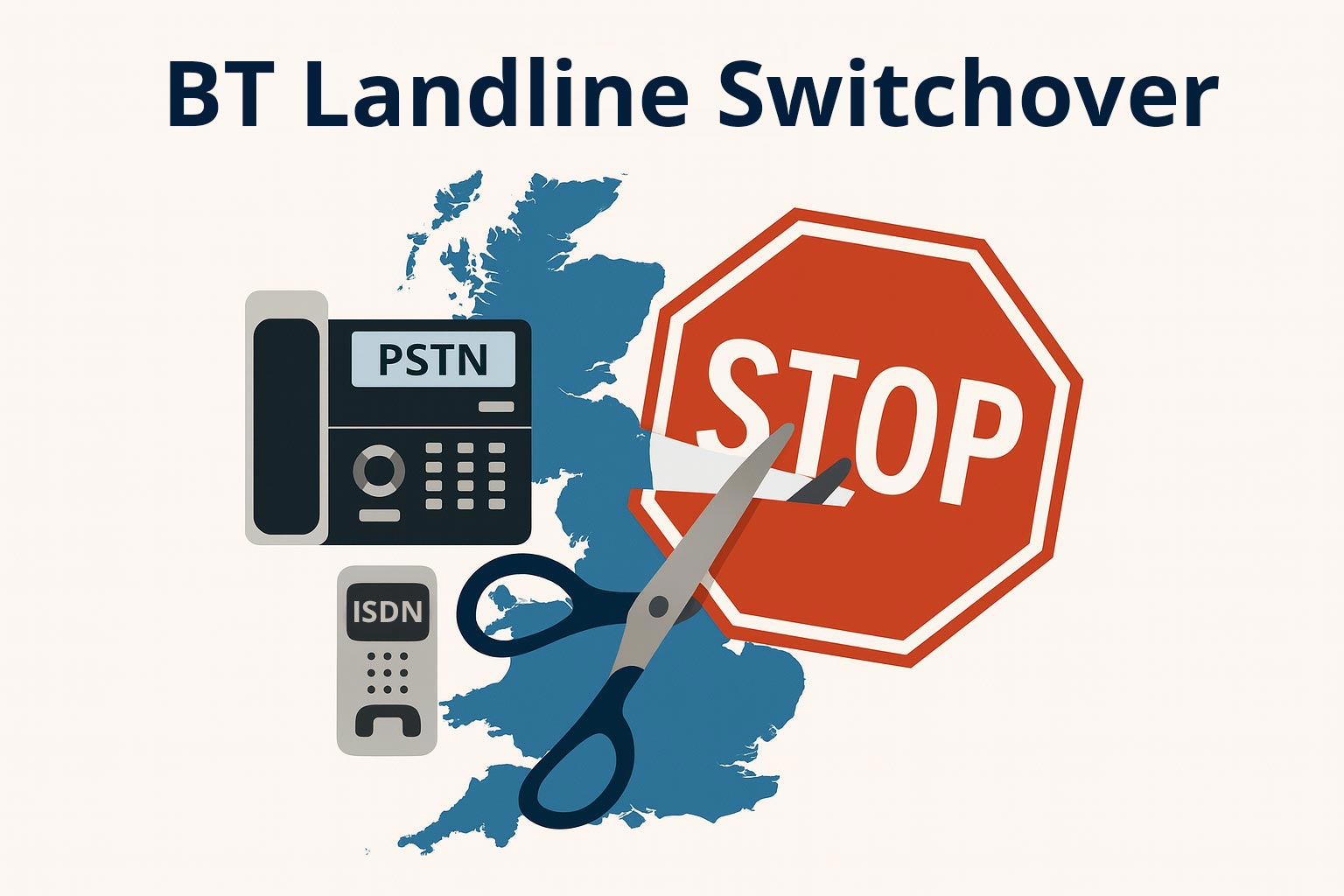
The UK’s communication infrastructure is undergoing its most significant transformation since the introduction of the digital exchange. By January 2027, the traditional Public Switched Telephone Network (PSTN) will be retired permanently. This guide provides the strategic roadmap UK business leaders need to navigate the transition without operational downtime.
Request a Migration Audit → https://stridecommunications.co.uk/contact/
Stride Communications Excellence
-
99.9% Uptime SLA on all Cloud Migrations
-
Cyber Essentials Certified Network Infrastructure
-
Official 3CX & Microsoft Solutions Provider
-
Direct UK-Based Technical Support (No Call Centres)
The Global Context & The UK Mandate: Why Copper is Retiring
The BT landline switchover is not merely a corporate decision; it is a physical necessity. The PSTN, parts of which rely on infrastructure laid over a century ago, is reaching the end of its life. For IT Managers and Ops Leads, understanding the “why” is critical to justifying the budget for “what” comes next.
The Physics of Failure: Electrolytic Corrosion
Copper cabling is susceptible to environmental degradation, specifically electrolytic corrosion. As water penetrates ageing underground conduits, the electrical current in the lines causes a chemical reaction that thins the copper. This leads to crackling lines, dropped calls, and total sync failure. Maintaining this legacy network has become economically and physically unsustainable for Openreach.
The All-IP Global Shift
The UK is not an outlier in this transition. The move to “All-IP” (Internet Protocol) is a global standard.
-
Germany & Japan: Have effectively completed their transitions, seeing a marked increase in national productivity through integrated data-voice systems.
-
France: Is currently phasing out copper by region, similar to the UK’s original roadmap.
-
The UK Mandate: By 2027, every voice call in the UK will travel as data packets.
For estate managers who may still be treating “phone lines” and “internet” as separate utilities, understanding the history of this shift is vital. You can read our deep dive on the Technical History of the PSTN Switch-Off to see how we arrived here.
Why 2027? The “Safety Pause” and the 2026 Urgency Gap
Originally slated for December 2025, the deadline was extended to January 2027. However, viewing this as a “delay” is a mistake that could lead to a resource bottleneck in late 2026.
The Telecare Crisis
The primary reason for the extension was the protection of vulnerable users. Legacy telecare devices (pendant alarms) often failed to signal over digital lines without specific adaptations. This led to the PSTN Charter, a voluntary agreement by providers to ensure no vulnerable customer is left without a working connection.
The 2026 “Resource Trap”
While the final switch-off is 2027, the “Stop-Sell” phase is already active across much of the UK. This means you can no longer buy new PSTN or ISDN services in most exchange areas.
| Feature | PSTN (Legacy) | All-IP (Modern) |
| Transmission | Analogue Signal | Data Packets (VoIP) |
| Hardware | Physical Copper | Fibre/Ethernet |
| Scalability | Fixed (requires engineer) | Instant (Software-based) |
| Maintenance | High (Physical repairs) | Low (Remote updates) |
Operational Tip: Engineering shortages will peak in Q3 and Q4 of 2026. Businesses that wait until the final six months will face premium installation costs and significant lead times.
The “Service Area” Impact: A National Connectivity Map
The switchover isn’t happening in a single “big bang” moment. It is a staggered rollout governed by the readiness of local exchanges to support Fibre-to-the-Premises (FTTP) or Single Order Generic Ethernet Access (SOGEA).
Regional Rollout Discrepancies
Large urban hubs like London, Manchester, and Birmingham have seen the highest adoption of digital alternatives. However, the challenge lies in rural “Not-Spot” areas where copper remains the primary lifeline. For businesses with multiple sites, this creates a fragmented communication estate where some offices are ready for Cloud PBX while others struggle with basic connectivity.
This fragmentation is particularly challenging for companies managing multiple locations. For a detailed strategy on unifying these disparate sites, we recommend reading our guide on SIP Trunking for Multi-Site PSTN Replacement.
Sector-Specific Deep Dives: Assessing Your Risk
The impact of the switchover varies wildly depending on your industry. A retail office has different needs than a 500-bed hospital or a manufacturing plant.
Healthcare & Care Homes
In healthcare, the switchover is a matter of life safety.
-
Nurse Call Systems: Many older systems dial out via an analogue port. During an All-IP transition, these signals can be compressed or “clipped,” meaning the emergency signal never reaches the monitoring centre.
-
Fall Pendants: These require an Analogue Telephone Adapter (ATA) to function on a digital line, or better, a full upgrade to a native IP system.
Education & Schools
Schools often rely on massive estates of analogue handsets.
-
Small Business Phone Systems adapted for education allow schools to retain their paging and “all-call” features while moving to a digital backbone. This transition often saves schools thousands in annual line rental.
Manufacturing & Industry
Manufacturing hubs face a unique threat: Telemetry.
-
Sensors on the factory floor, lift alarms, and remote gate entry systems often dial out via PSTN.
-
For these environments, SIP Trunking provides a robust bridge for legacy equipment, allowing a modern IP signal to communicate with older hardware via a gateway.
Proprietary Insight (Migration Risk Index): Stride’s internal data suggests that 65% of UK manufacturing firms have at least one “hidden” analogue line used for a critical safety system (e.g., a boiler alarm) that is currently unmapped in their IT inventory.
The “Hardware Audit” Encyclopedia: What Will Break?
A common misconception is that the switchover only affects “phones.” In reality, anything that plugs into a standard BT wall socket is at risk.
1. Lifts (EN81-28 Compliance)
Under UK law, lifts must have an emergency communication system. Many of these are hardwired to PSTN lines because the lines provide their own power. Digital lines do not. If the power goes out, the digital line dies—unless you have a battery-backed GSM or UPS solution.
2. Alarms (RedCARE/Dual-Path)
Legacy RedCARE systems rely on the “heartbeat” of a PSTN line. Crucially, BT RedCARE operations are closing in 2025, well before the final 2027 switch-off. If you haven’t upgraded your alarm dialler to a dual-path GPRS/IP solution, your insurance may be void.
3. The Fax Machine
The “Fax-over-IP” (FoIP) failure rate is notoriously high due to packet loss. If your business still requires faxing (common in legal and medical sectors), you must move to a Fax-to-Email service to ensure document integrity.
4. ISDN Circuits
Many businesses still run ISDN2 or ISDN30 circuits for their main PBX. These are being retired alongside the PSTN. For specific technical details on replacing these circuits, consult our ISDN Technical Guide 2027.
The Solution Stack: Your New Digital Core
When the copper lines go dark, your business will need a new way to communicate. The choice usually falls between three primary technologies.
VoIP vs. Cloud PBX
While often used interchangeably, VoIP is the technology (Voice over IP), while a Cloud PBX is the service. For most firms, moving to VoIP Phone Systems offers a 40–60% reduction in monthly costs compared to traditional line rental.
The Microsoft Teams Transition
Many businesses already pay for Microsoft 365. By integrating the Microsoft Teams Phone System, you can turn your laptop or mobile into your business landline. This eliminates the need for physical desk phones entirely and supports a hybrid workforce.
The 3CX Edge
For organisations requiring complex call routing, call recording, and CRM integration, a 3CX Phone System offers a software-based solution that can be hosted in the cloud or on-premise, providing maximum flexibility.
Financial Planning & ROI: The Digital Dividend
While the switchover requires an initial investment in hardware or setup, the Long-Term ROI is significant.
-
Removal of Line Rental: You no longer pay for individual physical lines. A single high-speed internet connection can handle hundreds of simultaneous calls.
-
Reduced Call Costs: Many VoIP plans include unlimited UK landline and mobile calls.
-
Maintenance Savings: With no physical “on-site” PBX box to maintain, expensive maintenance contracts are replaced by simple monthly subscriptions.
Cost of Inaction Table
| Expense Category | Staying on PSTN (Pre-2027) | Transitioned (Post-2027) |
| Line Rental (per line) | £20–£30 / month | £0 (Included in Data) |
| Emergency Call-outs | High (Ageing lines) | Low (Software-based) |
| Moving Office | Massive (Re-cabling) | Instant (Plug & Play) |
| Integration | Non-existent | High (CRM/AI/Data) |
The Logistics of Transition: Porting and Connectivity
Migration is not as simple as “plugging in a new phone.” There are two critical hurdles: Number Porting and Connectivity types.
Number Porting : The LOA Process
Your business phone number is a core asset. Moving it from BT to a digital provider requires a Letter of Authority (LOA). This process can take anywhere from 10 to 22 days. Errors in the “administrative address” held by BT can cause ports to fail, leading to downtime.
SOGEA vs. FTTP
With the death of the phone line comes the rise of “Broadband only” lines.
-
SOGEA (Single Order Generic Ethernet Access): Delivers broadband over existing copper but without a dial-tone.
-
FTTP (Fibre to the Premises): Is the gold standard, offering speeds up to 1Gbps and total reliability.
Consult our specialists regarding business broadband to determine if SOGEA or FTTP is available at your specific postcode.
Future-Proofing: Life Post-2027
Once your business is on an All-IP network, the “phone” stops being a siloed tool and becomes part of your data stack.
-
AI & Transcription: Every call can be automatically transcribed and summarized in your CRM.
-
Unified Communications: Your desk phone, mobile app, and laptop all ring simultaneously, ensuring no “First Contact” opportunities are missed.
The 2027 Action Plan Checklist
Use this 12-month roadmap to ensure your business is ready for the January 2027 deadline. For a comprehensive, step-by-step breakdown of how to execute each of these stages, please refer to our Business VoIP Migration Guide.
-
[ ] Conduct a Line Audit: Identify every active PSTN/ISDN line.
-
[ ] Identify “Hidden” Devices: Check lifts, alarms, and gate entries.
-
[ ] Test Connectivity: Ensure your office has SOGEA or FTTP availability.
-
[ ] Review Contracts: Ensure you aren’t signing a new 3-year deal for a dead technology.
-
[ ] Select Your Platform: Choose between Teams, 3CX, or a standard Hosted VoIP.
-
[ ] Map Your Call Flow: Do you still need that “Press 1 for Sales” menu?
-
[ ] Hardware Check: Decide if you want physical desk phones or softphones.
-
[ ] Start the Porting Process: Move your numbers at least 6 months before the deadline.
-
[ ] Staff Training: Ensure the team knows how to use the new features.
-
[ ] Decommission Old Lines: Stop paying for what you don’t use.
Ready to start? Contact us today to begin your migration audit and ensure no detail is overlooked.
Technical Glossary for the BT Switchover
-
PSTN: Public Switched Telephone Network (The old analogue network).
-
ISDN: Integrated Services Digital Network (The “digital” version of PSTN, also being retired).
-
SIP: Session Initiation Protocol (The technology that carries voice over the internet).
-
SOGEA: Broadband that doesn’t require a phone line.
-
Latency: The delay in data transfer; critical for high-quality voice calls.
-
Jitter: The variation in packet arrival time; causes “robotic” sounding voices.
Secure Your 2027 Migration Strategy Today → https://stridecommunications.co.uk/contact/
Frequently Asked Questions: The 2027 Transition
Q: Will my business phone numbers change after the switchover?
A: No. As long as you begin the Number Porting process before your physical lines are decommissioned, you can move your existing business numbers to any digital platform (VoIP, 3CX, or Teams). We recommend starting this process at least 6 months before the January 2027 deadline to avoid administrative bottlenecks.
Q: What happens if there is a power cut?
A: Unlike legacy PSTN lines, which were self-powered from the exchange, digital phones rely on your office router and internet connection. If the power goes out, your phones will go down. Stride recommends a “Dual-Resilience” strategy: an Uninterruptible Power Supply (UPS) for your onsite hardware and a mobile-app fallback that allows staff to receive calls on their smartphones via 4G/5G.
Q: Do I need to buy all new hardware?
A: Not necessarily. Many businesses choose to move to “Softphones” (calling via a laptop or mobile app), which requires zero new hardware. However, if you prefer physical desk phones, you will need IP-enabled handsets. In some cases, legacy analogue phones can be retained using an ATA (Analogue Telephone Adapter), though this is often a short-term fix rather than a long-term solution.
Q: Is the 2027 deadline the same for everyone?
A: January 31, 2027, is the “Final Sunset” date for the entire UK. However, your specific exchange may reach its “Stop-Sell” or “Withdrawal” phase much earlier. If your local exchange is already “Fibre-First,” you may be unable to make any changes to your current legacy setup today.
Q: Will my credit card machines and alarms still work?
A: Only if they are IP-compatible. Older PDQ machines and “RedCARE” alarm systems that dial out via a standard phone line will fail. Notably, BT Redcare is closing operations in 2025, so security and fire systems must be migrated to a dual-path GPRS/IP solution immediately to maintain insurance compliance.
Q: Can I use Microsoft Teams as my only phone system?
A: Yes. Through a process called Direct Routing, Stride can connect your business numbers directly to Microsoft Teams. This allows you to make and receive external calls from the Teams interface, effectively replacing your traditional PBX.
About the Author
Written by: Bhav Telecommunications Migration Specialist Bhav is a veteran in the UK telecoms landscape, specializing in multi-site IP-PBX architecture and legacy-to-IP transition strategies. With a deep technical background in ISDN PRI environments, he has successfully led hundreds of UK businesses through the pre-2027 PSTN migration process.
Article Freshness & Accuracy Last Updated: January 04, 2026
Fact-Checked by: Stride Technical Engineering Team
This guide is reviewed quarterly to reflect the latest Openreach “Stop Sell” exchange updates and Ofcom regulatory changes.