
What is VoIP? The Complete 2026 Guide to Voice over IP Technology for Business
Voice over Internet Protocol (VoIP) is the technology that enables you to make and receive phone calls over an internet connection rather than traditional copper phone lines. For any UK business today, it is not merely an optional upgrade; it is the mandatory foundation for all future communication, essential for survival in the post-PSTN era.
2027 PSTN switch-off ready
5★ Rated

25 Years' UK Experience
Trusted by 1000+ UK Businesses
99.9% Uptime Guarantee
UK-Based Personal Support
At Stride Communications, we view VoIP not as a feature, but as the underlying architecture that powers flexible, cost-effective, and fully scalable business communication systems. This comprehensive guide provides IT managers and business leaders with the definitive technical, financial, and regulatory breakdown necessary to confidently make the transition.
Why UK Businesses Must Replace ISDN Lines
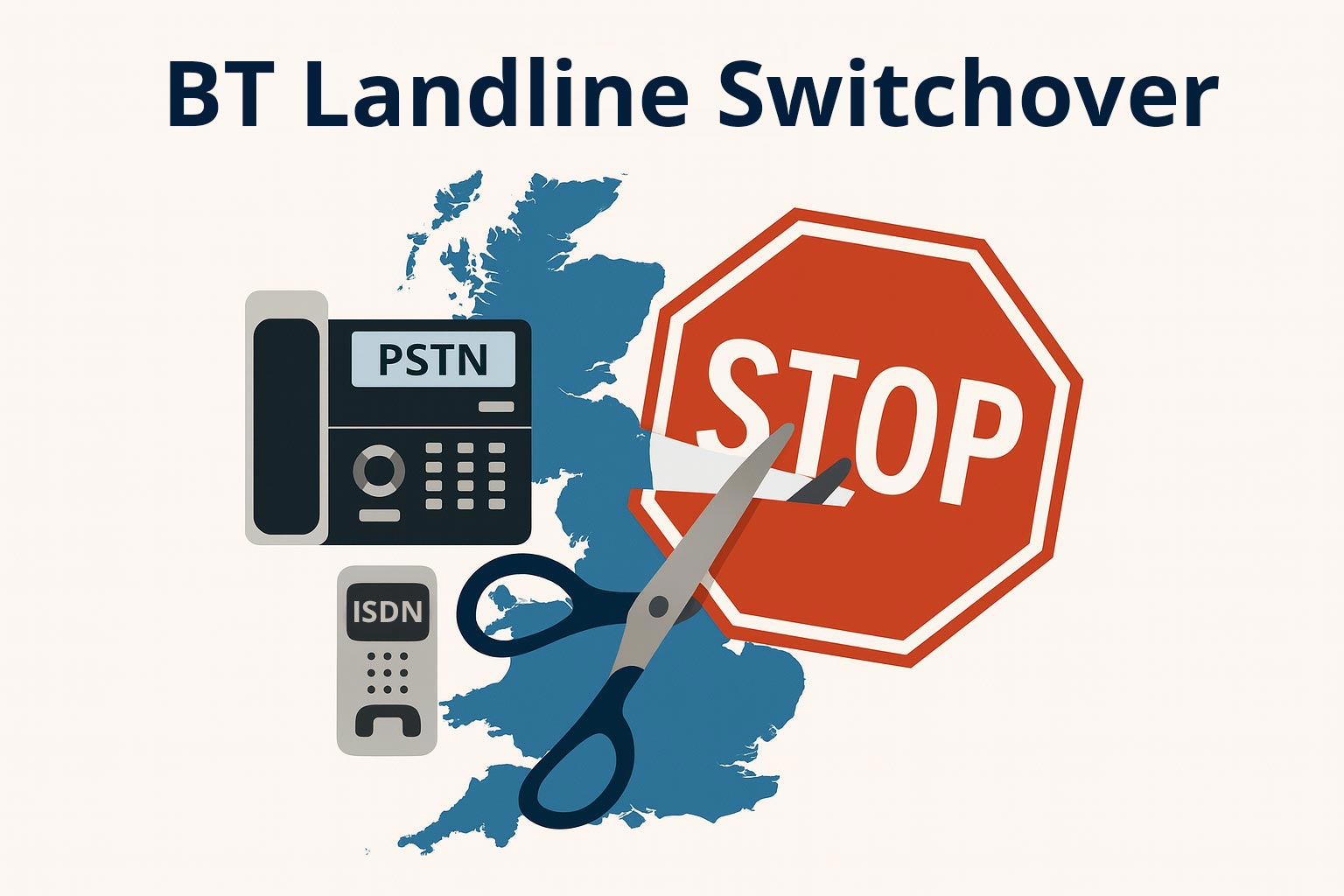
The most critical factor driving the adoption of VoIP across the UK is the retirement of the country’s legacy Public Switched Telephone Network (PSTN) and Integrated Services Digital Network (ISDN). The infrastructure underpinning these services is rapidly deteriorating, becoming technologically obsolete, and proving cost-prohibitive to maintain.
The Deadline
BT Openreach has set a stop-sell date of September 2025 for all new PSTN/ISDN connections, with a full switch-off planned for 2027. After this date, traditional services will cease to function.
The Implication
This is not a voluntary decision; it’s a necessary compliance measure and a matter of business continuity. Remaining on an old system risks sudden outages, difficulty sourcing replacement parts (for existing on-premise PBX systems), and unavoidable disconnection upon final network retirement. Migration must be planned now to avoid the inevitable rush and resource scarcity that will hit the market closer to the deadline. Transitioning early allows businesses to leverage this technological mandate to drive strategic operational improvements rather than simply managing a forced switch.
For a comprehensive breakdown of the switch-off timeline, migration risks, and immediate actions your business needs to take, read our dedicated guide: PSTN & ISDN Switch-Off: Business VoIP Migration
How VoIP Works: A Technical Deep Dive into Voice Packets
To maintain high call quality (often referred to as HD Voice or Wideband Audio), it’s vital to understand the protocols that govern VoIP calls. Unlike traditional telephony, which uses a continuous circuit, VoIP converts your voice into small digital data packets and transmits them over the internet.
The Conversion Process: Analogue, Digital, and the Codec
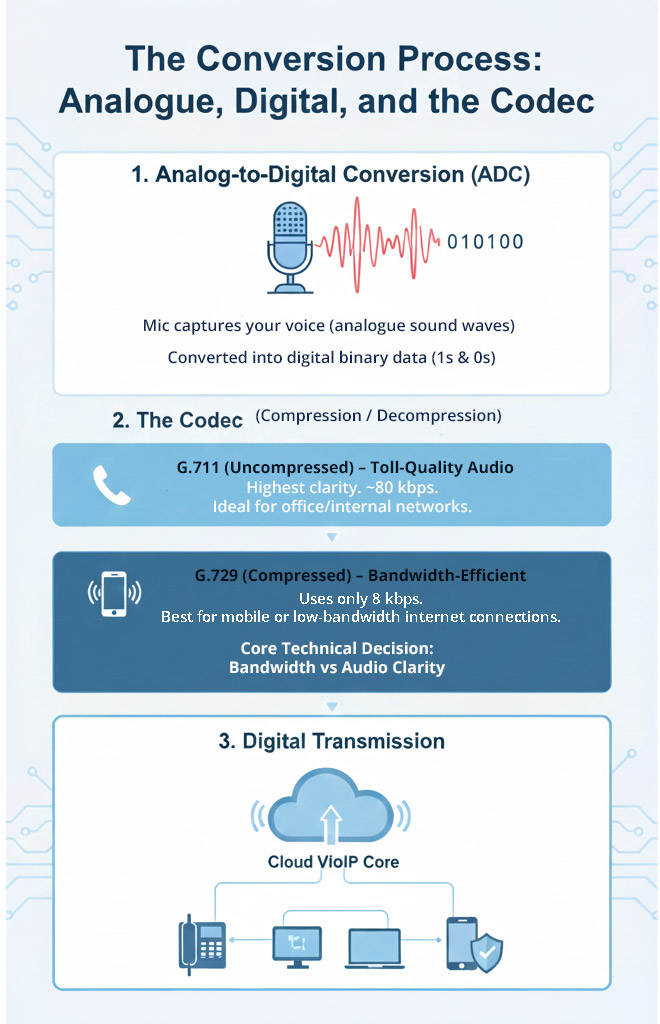
The conversion process from sound waves to digital data involves three critical components:
Analog-to-Digital Conversion (ADC)
Your microphone (on your handset or headset) captures your voice, an analogue signal. This signal is sampled thousands of times per second and converted into a digital binary stream (1s and 0s).
The Codec (Compression/Decompression)
This is the most important component for quality and bandwidth. The Codec's job is to shrink the digital voice data to optimize it for transmission. The choice of codec is a core technical decision influencing bandwidth consumption and call clarity. G.711 (Uncompressed): The "toll quality" standard. Highest clarity, lowest processing latency, but uses the most bandwidth (~80 kbps per call). Ideal for internal network calls. G.729 (Compressed): Operates at a much lower bitrate, consuming only 8 kbps. Bandwidth-efficient for calls over the public internet, making it ideal for mobile softphone users or satellite offices.
The VoIP Protocol Stack: SIP, RTP, and the SBC
SIP (Session Initiation Protocol): The Signalman
SIP is a signaling protocol responsible for setting up, managing, and tearing down the communication session. It handles user registration, authentication, call forwarding, and feature invocation via commands like INVITE, ACK, and BYE. Modern deployments favor SIP over TLS(Transport Layer Security) to encrypt the signaling channel.
RTP (Real-time Transport Protocol): The Carrier
RTP carries the actual voice data (the payload) continuously once the call is established. It relies on timestamps and sequence numbers to allow the receiving endpoint to reconstruct the voice stream accurately, minimizing jitter.
The Session Border Controller (SBC): The Firewall and Translator
The SBC is a specialized network element placed at the border between Stride's network and your business network. It is crucial for enterprise-grade VoIP and serves multiple functions: Security (protecting the PBX from DoS attacks), NAT Traversal (resolving complex private/public IP issues), andProtocol Normalization (translating signaling differences).
Two main protocols manage the call session and media, but a third network element ensures security and interoperability:
The ROI and Business Case for Cloud Telephony
Moving from legacy systems (PSTN/ISDN) to VoIP fundamentally changes your financial model, offering substantial long-term savings and increased efficiency by shifting telephony from heavy Capital Expenditure (CapEx) to a predictable Operational Expenditure (OpEx).
| Cost Element | Traditional ISDN/PSTN (CapEx Model) | Cloud VoIP (OpEx Model) | Financial Impact for Stride Clients |
|---|---|---|---|
| Initial Investment | Large upfront PBX server, physical cards, and installation fees (easily £5k–£50k for an SME) | None (managed entirely by Stride); costs are limited to manageable handset purchases. | Eliminates initial capital expenditure and avoids rapid hardware depreciation risks. |
| Hidden Costs | Electricity to power PBX, air conditioning for server room, complex maintenance contracts, cost of lost productivity during PBX failures. | Consolidates all costs into a single, tax-deductible monthly fee. | Simplifies IT budgeting; converts opaque, variable costs into predictable OpEx. |
| Scaling | Waiting for engineer, paying for new physical lines/cards; scaling down means sunk costs remain. | Users/licenses added or removed instantly via a web portal. | Extreme flexibility for seasonal businesses or rapid growth phases. |
| Call Costs | High rates for international/mobile calls, especially if a contract is not fully utilized. | Often includes unlimited UK national and mobile minutes, a key saving area. | Significant reduction in variable call charges, often lowering average telephony expenditure by 40% to 60%. |
Mobility and Presence
Employees use the Softphone App to use their official office number from any location, with real-time Presence indicators showing colleagues' availability (On Call, Available, Away).
Business Continuity (Disaster Recovery)
Unlike ISDN, which offers no remote redundancy, VoIP enables instant call routing to employee mobile apps or another physical site in the event of an office power outage or network failure, guaranteeing zero downtime. This fulfills critical obligations for business continuity planning.
Strategic Benefits: Flexibility and Future-Proofing
VoIP is the foundation for a modern, hybrid UK workplace:
The Network Foundation: Advanced QoS and Reliability
The only ‘disadvantage’ of VoIP is its reliance on a stable internet connection. However, this is fully mitigated by professional Quality of Service (QoS) configuration and the right connectivity. Call quality is a function of your network planning, not the technology itself.
Traffic Classification (DSCP Tagging)
This is the industry-standard method. Voice packets are 'marked' with a high-priority code in the IP header (DSCP 46/EF - Expedited Forwarding). Your network switches and routers recognize this tag and ensure the voice packets are prioritized ahead of all other traffic.
Queuing and Bandwidth Management
Once classified, QoS uses techniques like Low Latency Queuing (LLQ) to reserve a small, high-priority bandwidth slice solely for voice traffic, ensuring it never gets caught in congestion.
Quality of Service (QoS) Deep Dive: The Key to Call Clarity
QoS is the mechanism used to guarantee voice quality over data. The goal is to achieve minimal latency (<150ms), low jitter (<30ms), and zero packet loss for voice traffic.
Calculation Example
A business using the G.711 codec requires approximately 100 Kbps of upload and download bandwidth per call (including overhead). For a 50-person office that experiences 10 simultaneous calls at peak time, you must reserve a minimum of 1 Mbps symmetrical bandwidth.
Contention Ratios
Traditional Fibre-to-the-Cabinet (FTTC) has high contention ratios (shared bandwidth). For reliable VoIP, an uncontended Fibre Leased Line or Fibre to the Premises (FTTP) is required to guarantee the necessary upload and download capacity.
Bandwidth Calculation and Network Sizing
Professional deployments require accurate bandwidth planning. Never rely on generalized consumer broadband.
Session Border Controllers (SBCs)
These are vital network elements placed at the edge of the network to manage traffic flow, enforce security policies, and normalize SIP signaling between Stride's core network and your internal infrastructure.
Essential UK Connectivity
For mission-critical communications, a Leased Line provides dedicated, symmetrical bandwidth with legally binding Service Level Agreements (SLAs) for uptime and latency. This is the only way to truly guarantee VoIP quality.
Mitigating the Reliability Risk
Ensuring secure, seamless, and high‑quality communications across every connection.
Advanced Features Driving UK Business ROI
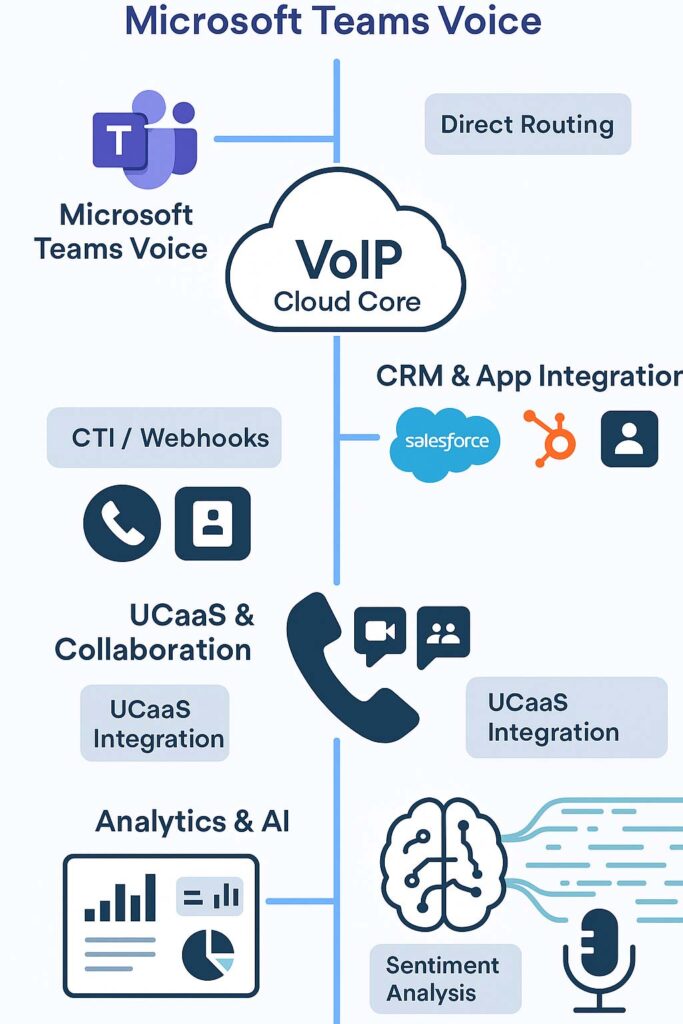
Microsoft Teams Voice (Direct Routing)
A critical feature for modern UK enterprises. Stride's Direct Routing service bypassMS Teams application to function as a fully featured PBX. Users can make and receive external PSTN calls directly within the familiar Teams interface.
CRM and Application Integration Deep Dive
CTI (Computer Telephony Integration) enables click-to-dial and the screen-pop feature, which instantly displays the customer's CRM record upon an inbound call. This cuts seconds off Average Handling Time (AHT) and dramatically improves the Customer Experience (CX). Stride's platform also utilizes secure API Webhooks to automate activity logging in platforms like Salesforce and HubSpot.
UCaaS: Integrating Voice with Collaboration Tools
VoIP is the engine for Unified Communications as a Service (UCaaS), integrating voice with a full stack of collaboration tools.
Call Analytics and AI Augmentation
The data generated by VoIP is a strategic asset:
Deep Queue Performance Metrics
Reports track abandonment rates, average speed of answer (ASA), service level adherence, and total waiting time, essential for Contact Centre operations.
AI Augmentation
Modern systems utilize AI for features like call transcription, sentiment analysis (identifying unhappy customers), and automated call summaries, transforming raw audio into actionable data for quality assurance and training.
Security, Compliance, and UK Regulatory Requirements
For any UK-based service provider, security and compliance are paramount. VoIP systems must adhere to specific UK and European mandates, especially when handling sensitive customer data.
SBC Hardening (External Defence)
The SBC is the first line of defence, rejecting malformed SIP packets, blocking unauthorized traffic, and preventing common Denial-of-Service (DoS) attacks that target VoIP platforms.
Firewall Configuration (Internal Defence)
Stride assists with disabling problematic features like SIP ALG (Application Layer Gateway), which frequently causes one-way audio and dropped calls, and ensuring correct pinhole configurations for SIP/RTP traffic through the local firewall.
SRTP and TLS Encryption
Encryption is non-negotiable. TLS (Transport Layer Security) secures the signaling channel, while SRTP(Secure Real-time Transport Protocol) encrypts the voice media stream itself, protecting all communications from interception over the public internet.
Security Architecture and Mitigation
MiFID II and FCA Compliance (Financial Services)
All communications leading to a transaction must be recorded and archived for a minimum of five years with tamper-proof integrity. Stride's systems provide compliant, secure cloud storage for recordings.
GDPR and Data Residency
Stride guarantees that all voice data is stored within secure, certified UK or EU data centres(data residency), and provides the necessary tools for subject access requests (SARs) and data retention policies.
PCI-DSS (Payment Card Industry Data Security Standard)
For businesses handling payments over the phone, compliance is achieved via DTMF masking or "DTMF clamping," where the customer’s tones when entering card details are replaced by flat tones, preventing the card number from being captured on the call recording.
PSTI Act 2022
This UK-specific mandate ensures that all internet-connected devices (including VoIP handsets and routers) meet base security standards regarding vulnerability disclosure and automatic software updates.
Critical UK Compliance Deep Dive
What Our Customers Say on Google
Real results from UK businesses who made the switch
1000+ UK businesses trust Stride | 5/5 average rating | 98% first-contact resolution
Frequently Asked Questions
Comprehensive Answers to Your VoIP Questions
Is VoIP more reliable than a traditional landline
From a modern business continuity perspective, yes, it is superior. While a landline is immune to internet failure, it is susceptible to physical cable cuts and exchange faults, which can take days to repair. VoIP relies on network redundancy, mobile application failover, and geographically separate data centres. If one connection fails (e.g., a local power outage), the system automatically routes calls to a mobile or another backup location in milliseconds, guaranteeing continuous operation.
What internet speed do I need for a 50-person office using G.729?
You need to calculate based on concurrent usage. Assuming a worst-case scenario of 20% concurrency (10 users on the phone at once) and using the compressed G.729 codec (estimated 25 Kbps total per call), you need approximately 250 Kbps of dedicated upload speed. However, a dedicated Fibre connection or Leased Line is strongly recommended to handle essential data alongside voice and ensure HD quality for internal calls. Crucially, the quality of the connection (low latency) is more important than the overall speed
What is the risk of using SIP ALG on my router?
SIP ALG (Application Layer Gateway) is notoriously problematic for VoIP and should be disabled. Its original intent was to help firewalls manage SIP traffic, but it frequently corrupts the SIP headers, leading to critical issues like one-way audio, dropped calls after 10-15 minutes, and phones failing to ring during inbound calls. A professional VoIP deployment relies on correctly configured NAT and STUN/TURN protocols, not SIP ALG.
Can I use my old ISDN-era phone handsets with a VoIP system?
In most cases, no, you cannot use the old digital or analogue handsets directly. They are incompatible with the IP protocols. However, you can use an ATA (Analogue Telephone Adapter) to connect older analogue devices (like fax machines, door entry systems, or older cordless phones) to the new IP network. This is common for retaining legacy equipment that only requires a basic dial tone.
What is the timeline for a full VoIP migration for a medium-sized UK business?
A standard migration for a business with 20-100 users typically takes 4 to 8 weeks from initial audit to final launch. This includes critical phases such as network readiness testing, number porting request processing (which is dependent on the losing provider), system configuration, and user training. The key to speed is having a certified partner like Stride manage the complex porting process to avoid delays.
The Mandate to Modernise
VoIP is the bedrock of modern business communication. By understanding the underlying technology (SIP, RTP, Codecs) and coupling it with a strong network foundation (QoS, Leased Lines), your business gains a massive competitive advantage in cost, flexibility, and resilience.
Don’t wait for the final PSTN deadline to force your hand. Transitioning now allows you to control the migration timeline, train your staff effectively, and immediately start benefiting from the advanced UCaaS features that drive productivity and customer satisfaction.