
VoIP Connectivity & QoS: The Technical Foundation for Reliable Business Voice
In a digital-first economy, your business is only as strong as its connection. As the 2025/2026 PSTN switch-off approaches, understanding the technical nuances of VoIP Connectivity & QoS (Quality of Service) is the only way to guarantee crystal-clear calls and zero downtime.
2027 PSTN switch-off ready
5★ Rated

25 Years' UK Experience
Trusted by 1000+ UK Businesses
99.9% Uptime Guarantee
UK-Based Personal Support
The Critical Role of Connectivity in Modern Telephony
Voice over Internet Protocol (VoIP) has transformed how UK businesses operate, but VoIP performance is entirely dependent on the quality of the underlying data circuit. Unlike standard web browsing, where a slight delay in loading a page is a minor inconvenience, voice data is “real-time.” If a packet of voice data is delayed or lost, the conversation breaks, leading to “robotic” audio or dropped calls. This makes the selection of a robust internet circuit the most important decision in your communication strategy.
At Stride Communications, we treat connectivity as the “Reliability Foundation.” Whether you are deploying a Cloud Phone System or connecting multiple offices via SIP Trunking, your network must be configured to prioritise voice traffic over standard background data like emails or file backups. Without this technical prioritisation, your business communications remain vulnerable to the ebbs and flows of public internet congestion.
Understanding the Three Killers of VoIP Quality
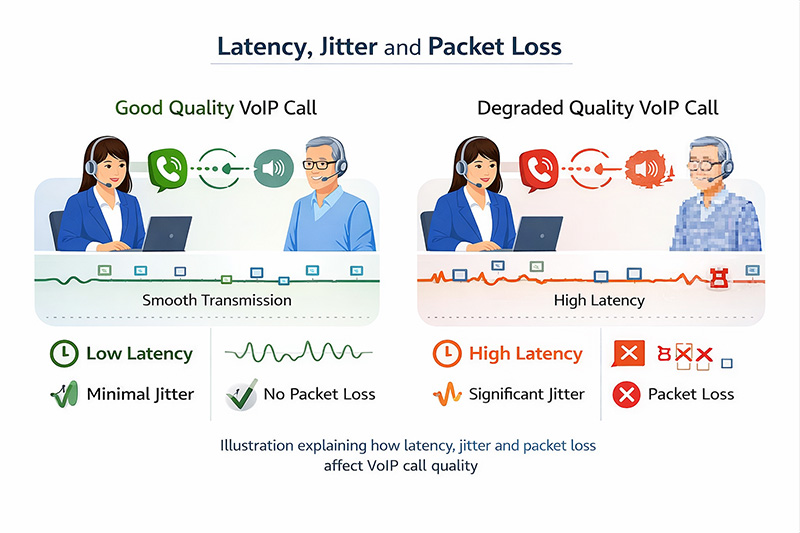
To maintain a professional image, your voice system must achieve a high Mean Opinion Score (MOS). This is a numerical measure of the human-perceived quality of a phone call. To keep this score high, Stride Communications focuses on mitigating the three primary technical adversaries of VoIP: Latency, Jitter, and Packet Loss.
1. Latency (The Communication Lag)
Latency is the time it takes for a voice packet to travel from the speaker’s mouth to the listener’s ear. High latency causes callers to "talk over" each other because of the delay. For business-grade quality, one-way latency should ideally remain below 150 milliseconds. Stride manages this by routing traffic through low-latency UK exchanges and avoiding unnecessary "hops" across the public internet.
2. Jitter (The Timing Inconsistency)
Jitter is the variation in the delay of received packets. If packets arrive at irregular intervals, the VoIP system must attempt to reorder them, often resulting in "robotic" or garbled speech. We eliminate jitter through the implementation of enterprise-grade Jitter Buffers and the use of uncontended fibre circuits that provide a stable, predictable data flow.
3. Packet Loss (The Audio Gaps)
Packet loss occurs when data packets fail to reach their destination. Even a 1% loss of packets can cause noticeable "drop-outs" in a conversation. This is typically a symptom of network congestion. By using a managed connection from Stride Communications, we ensure your voice packets are never "dropped" in favour of less critical data.
What is QoS and Why is DSCP Tagging Mandatory?
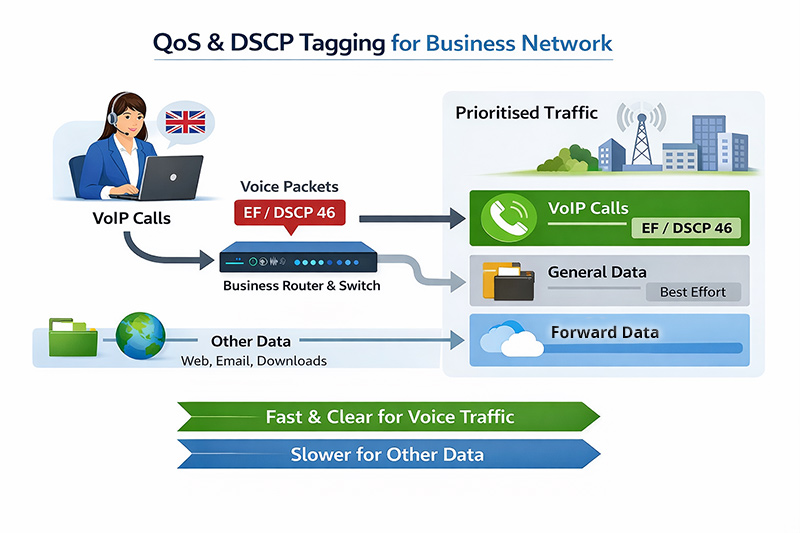
Quality of Service (QoS) is a suite of technologies that manage network resources by prioritising specific types of data. Stride Communications implements strict QoS protocols to ensure voice always has the “right of way.”
DSCP Tagging: The technical mechanism we use to label your voice traffic. By applying a specific tag (EF or Expedited Forwarding) at the router level, we move those packets to the front of the queue. Essential for 3CX or Microsoft Teams.
Comparing Business Connectivity: FTTP vs. Leased Lines
Choosing the right circuit type is the first step in building a reliable VoIP foundation. As the UK phases out legacy copper lines, businesses must choose between shared (contended) and dedicated (uncontended) fibre solutions.
| Feature | SOGEA / FTTP (Shared) | Dedicated Leased Line |
|---|---|---|
| Bandwidth | Shared with other businesses | 100% Dedicated to you |
| Contention Ratio | High (Varies by time of day) | 1:1 (No contention) |
| Symmetry | Faster downloads than uploads | Symmetrical (Matching speeds) |
| SLA | Best Effort | 99.9% - 100% Guaranteed |
| VoIP Capacity | Suitable for 1-15 users | Unlimited Scaling |
| Service Fix Time | 1-3 Working Days | 4-6 Hour Fix Guarantee |
For businesses that cannot afford a single minute of downtime, a Dedicated Leased Line is the gold standard. It provides the symmetrical upload speeds required for high-quality voice and video conferencing, backed by the most rigorous SLA in the UK market.
Stride Proprietary Insight: The Stride Connectivity Health Score
Most providers perform a simple “Speed Test”. At Stride Communications, we believe speed is a vanity metric; stability is the sanity metric. We utilize our proprietary Stride Connectivity Health Score (SCHS) to evaluate network readiness.
The SCHS analyzes “Bufferbloat“—the latency spike that occurs when your router is overwhelmed. We run a 24-hour stress test that simulates peak-hour traffic to ensure your network can maintain voice priority under pressure.
Internal LAN Architecture
-
Voice VLAN Isolation: Virtual isolation for handsets.
-
PoE Switching: Power and data via single cable.
-
Throughput Management: High PPS handling.
Optimising Internal LAN Architecture for Voice
The best external connection in the world can be ruined by a poorly configured internal Local Area Network (LAN). To ensure end-to-end quality, Stride Communications focuses on three internal pillars:
1. Voice VLAN Isolation
We create a Virtual Local Area Network (VLAN) specifically for your phone handsets. This separates your voice traffic from your PCs and printers, preventing local data spikes from causing audio interference.
2. PoE (Power over Ethernet) Switching
We deploy high-quality PoE switches that provide both power and high-speed data to your desk phones. This simplifies cabling and ensures that your https://stridecommunications.co.uk/voip-phone-systems/ remain active even if local power is fluctuating.
3. Router Throughput Management
Many standard routers cannot handle the “Packet Per Second” (PPS) requirements of a large VoIP system. We specify and configure enterprise-grade routers that are optimized for the heavy demands of modern business communications.
Connectivity Success in Action
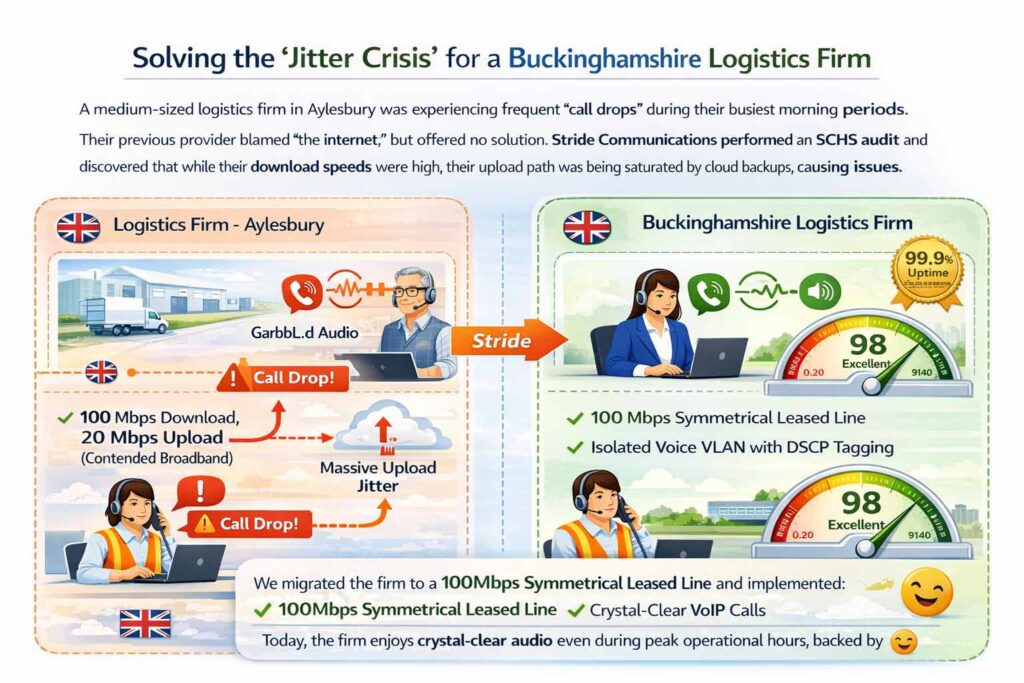
Illustrative Example: Solving the “Jitter Crisis” for a Buckinghamshire Logistics Firm
A medium-sized logistics firm in Aylesbury was experiencing frequent “call drops” during their busiest morning periods. Their previous provider blamed “the internet,” but offered no solution. Stride Communications performed an SCHS audit and discovered that while their download speeds were high, their upload path was being saturated by cloud backups, causing massive jitter.
We migrated the firm to a 100Mbps Symmetrical Leased Line and implemented DSCP tagging at the router level. By isolating their voice traffic on a dedicated VLAN, we eliminated call drops entirely. Today, the firm enjoys crystal-clear audio even during peak operational hours, backed by our 99.9% uptime guarantee.
Decision Block: Is Your Connection Voice-Ready?
Before you commit to a new phone system, use this technical checklist to evaluate your current connectivity:
Upload Speed
Do you have at least 100kbps of uncontended upload bandwidth per concurrent call?
Contention Ratio
Is your line shared with 50 other businesses (1:50) or is it dedicated (1:1)?
Hardware
Does your router support DSCP/QoS prioritisation and Voice VLANs?
Ping/Latency
Is your average ping to a UK-based server consistently under 30ms?
Security
Is your connection protected by a VoIP-aware firewall?
Security Architecture and Mitigation
If you cannot answer "Yes" to all five, your business is at risk of poor call quality and lost revenue.
Why Choose Stride for Connectivity & QoS?
Stride Communications is more than just a VoIP reseller; we are a full-service connectivity partner. We manage the entire “packet journey” from your desk phone to our core network.
UK Sovereignty
Our traffic is routed through UK data centres, ensuring the lowest possible latency for UK-to-UK calls.
Proactive Monitoring
We see the jitter before you hear it. Our monitoring tools alert our UK support team the moment your connection metrics dip below our SLA thresholds.
Expert Configuration
We don’t just “plug it in.” We configure every switch and router to ensure your phone perform as promised.
What Our Google Review Customers Say About Call Quality
Real results from UK businesses who made the switch
1000+ UK businesses trust Stride | 5/5 average rating | 98% first-contact resolution
Technical FAQs: VoIP Connectivity & QoS
Does VoIP use a lot of data?
No. A standard VoIP call uses roughly 85kbps to 100kbps of bandwidth. The issue is not the amount of data, but the timing and priority of that data. One large email attachment can “choke” a VoIP call if QoS is not implemented.
Can I use my home broadband for business VoIP?
While possible for a single user, residential broadband is “best-effort” and highly contended. For a professional office environment, we always recommend a business-grade circuit like FTTP or a Leased Line to ensure reliability.
What is the difference between SOGEA and FTTP?
SOGEA is “Single Order Generic Ethernet Access”—it provides broadband over a copper line but without the traditional phone dial tone. FTTP is “Fibre to the Premises,” which is pure fibre. FTTP is generally more stable and faster, making it better for VoIP.
Why are symmetrical speeds important?
VoIP is a two-way street. You need to “send” voice data just as fast as you “receive” it. Asymmetrical connections (like standard ADSL) have slow upload speeds, which is the #1 cause of “one-way audio” issues.
How does the 2027 PSTN switch-off affect my internet?
Old ADSL and FTTC connections rely on the legacy copper network. As these are retired, businesses must move to fibre-based connectivity. Stride Communications helps you navigate this transition to ensure your internet and phones stay online.
What happens to my VoIP calls if the internet goes down?
Stride provides multiple failover options, including 4G/5G backup and secondary fibre circuits. If your primary line fails, your calls can automatically reroute to the backup or to a mobile app on your smartphone.
Does Stride manage the routers?
Yes. We provide fully managed routers that are pre-configured with QoS and DSCP tagging, taking the technical burden off your internal IT team.
Is a Leased Line worth the extra cost?
For any business with 20+ users or mission-critical voice requirements, yes. The cost is offset by the 100% uptime guarantee, the symmetrical bandwidth, and the significantly higher call quality.
Next Steps for a Reliability Foundation
Building a world-class communication system starts with the circuit. Don’t let a poor connection undermine your investment in a modern phone system. Stride Communications provides the technical expertise and the high-performance network you need to succeed.
1
Audit
Run the Stride Connectivity Health Score on your current network.
2
Upgrade
Move to a voice-optimised FTTP or Leased Line circuit.
3
Configure
Implement end-to-end QoS and Voice VLANs.
4
Connect
Deploy your Cloud Phone System with total confidence.