Phone Systems for Healthcare: Clinical Grade Communications
Effective communication is the foundational gateway for patient access and clinical safety within the UK healthcare sector. A healthcare business phone system must function as a resilient utility, capable of managing high-frequency call volumes while adhering to strict regulatory frameworks. For General Practices, dental clinics, and secondary care providers, the transition from legacy copper lines to modern IP-based telephony is a critical step in maintaining operational continuity and patient trust.
2027 PSTN switch-off ready
5★ Rated
CQC Compliant
Call recording and data handling that meets regulatory audits
NHS DSPT Aligned
Verified security protocols for patient data protection
99.99% Uptime SLA
Guaranteed clinical-grade reliability
UK-Based Dedicated Support
Personal assistance from our Buckinghamshire headquarters.













Telephony in healthcare is more than a communication tool; it is a critical component of clinical governance. The ability of a patient to reach their provider during the “8am rush” directly impacts health outcomes and regulatory standing.
Why Telephony is a Clinical Governance Priority
The Care Quality Commission (CQC) increasingly scrutinizes how easily patients can access services. A system that results in frequent “engaged” tones or excessive wait times can lead to poor “Responsiveness” ratings. By implementing cloud-based telephony, practices can provide the CQC with transparent data on call abandonment rates, average time to answer, and patient journey mapping, proving a commitment to compliance and security standards.
Automated Call-Back Functionality
Under the Data Security and Protection Toolkit (DSPT) framework, healthcare providers must ensure that all patient-identifiable data—including voice recordings—is stored securely. Our infrastructure maintains strict UK data residency. This ensures that clinical discussions and patient metadata never exit the UK jurisdiction, satisfying the most stringent GDPR and NHS data sovereignty requirements.
Data Sovereignty and the NHS DSPT
Solving the “8am Rush”: Queue Management Strategies
The “8am rush” remains the primary pain point for UK primary care. Modern telephony architecture resolves this through intelligent automation.
Automated Call-Back Functionality
The needs of a startup or small to medium enterprise (SME) are distinct from those of a large corporation. You need maximum functionality for a minimal budget, and critically, the solution must be ready to use today. This section addresses the core pain points: high costs, complexity, and a lack of mobility.
- Number of callers currently in the queue.
- Average wait times.
- Live agent status (who is on a call, who is in "admin mode" following a consultation). This data allows for dynamic staffing adjustments, ensuring that peak periods are handled with maximum efficiency.
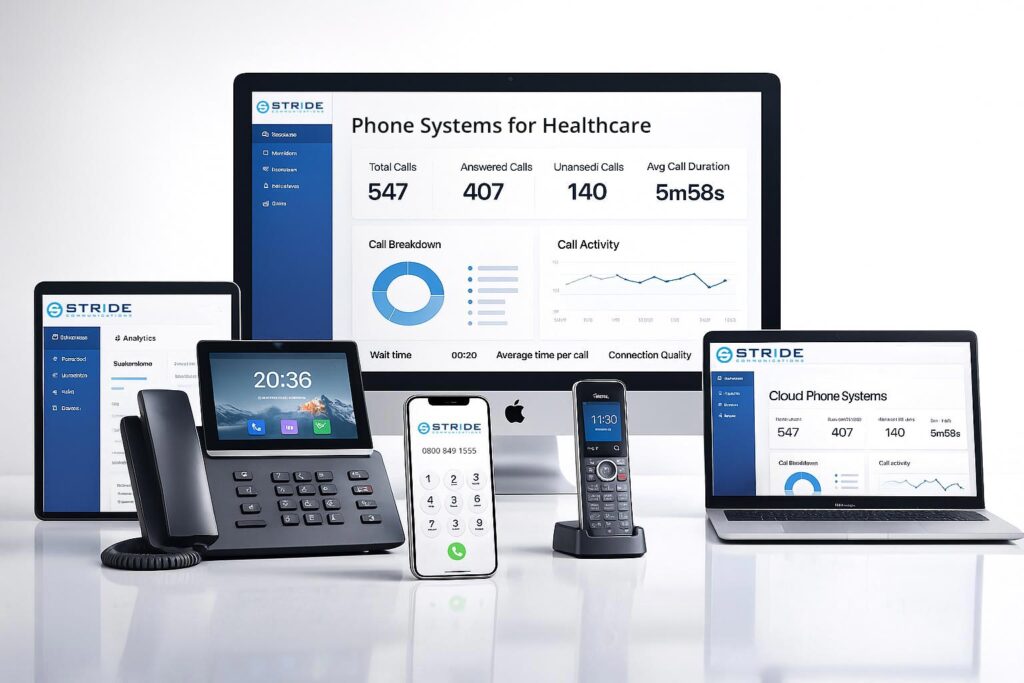
Real-Time Wallboards for Practice Managers
Practice managers need visibility to manage resources effectively. Our real-time dashboards display:
Core Mechanisms of a Healthcare-Grade VoIP System
A modern healthcare phone system replaces the limitations of hardware with the flexibility of software, integrating directly into the clinical workflow.
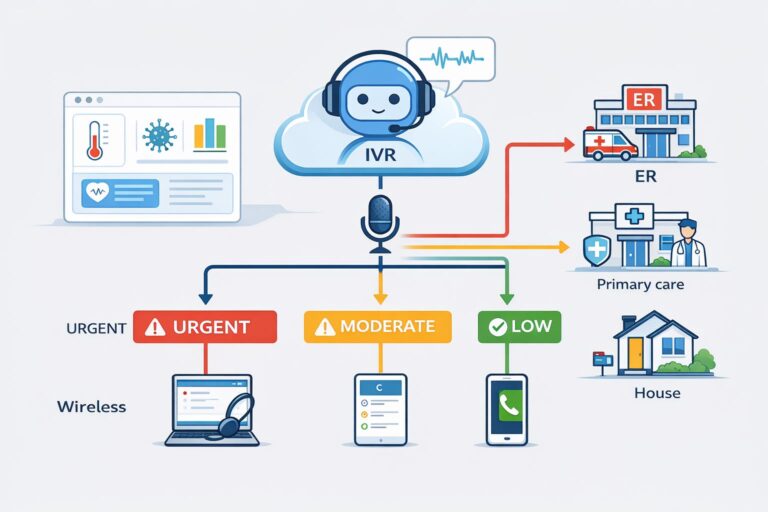
Intelligent Patient Triage (IVR Design)
The Interactive Voice Response (IVR) is the digital front door of the practice. Instead of a generic menu, healthcare-specific IVR designs prioritize patient safety:
Emergency Redirection: Immediate prompts to dial 999 for life-threatening symptoms.
Segmented Routing: Separating prescription queries, test results, and appointment bookings to ensure the right staff handle the right calls.
Clinical Priority Queuing: Using caller ID recognition to move vulnerable patients or palliative care providers to the front of the queue.
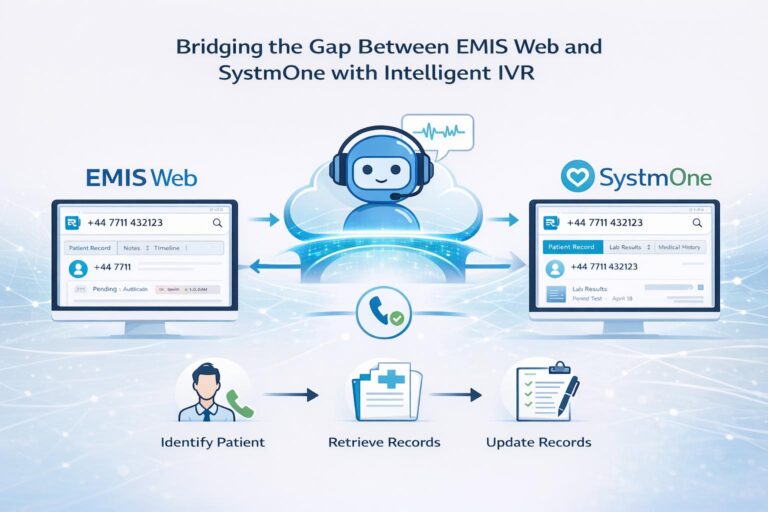
EMR Integration: EMIS Health & SystmOne
One of the most significant efficiency gains comes from integrating the phone system with Electronic Medical Records (EMR).
The “Screen Pop”: When a patient calls, the system cross-references the phone number with the EMIS or SystmOne database. Before the receptionist even answers, the patient’s clinical record appears on their screen.
Reduced Administrative Friction: This integration saves an average of 30–60 seconds per call by eliminating manual identity verification and record searching, allowing for more focused patient interaction.

Secure Call Recording & Redaction
For medical-legal protection and staff training, secure call recording is essential.
Automated Redaction: Our systems use intelligent triggers to pause recording during the exchange of highly sensitive information, such as credit card details for private clinics or specific sensitive identifiers, ensuring PCI-DSS compliance.
Caldicott Guardian Controls: Access to recordings is restricted via granular permissions, ensuring only authorized personnel can review clinical consultations, with a full audit trail of every access attempt.
Clinical Compliance, Data Sovereignty and CQC Alignment
Data protection in a medical environment is governed by stringent NHS-approved encryption protocols that exceed standard commercial requirements. All voice data, including call metadata and recorded consultations, must be handled with absolute integrity to satisfy GDPR and NHS data security protocols.
Aligning Telephony with CQC Inspection Domains
For Practice Managers and Partners, a phone system is evidence for the CQC. Our infrastructure provides tangible data for inspection:
Safe: Secure call recording and encrypted pathways protect clinical advice.
Effective: Integration with EMIS Web and TPP SystmOne reduces clinical risk.
Responsive: Detailed reporting on wait times proves the practice is accessible.
Well-Led: Granular audit trails demonstrate high-level digital governance and accountability.
To understand the underlying security layers used to protect patient data, you should review our guide on compliance and security standards.
UK Data Residency & The Caldicott Mandate
Unlike generic VoIP providers who may route traffic through international data centres, Stride Communications ensures that data sovereignty is absolute. Every packet of voice data and every byte of stored recording remains within Tier-3 UK data centres. This ensures the Caldicott Guardian can maintain oversight of patient identifiable information (PII) in full alignment with the Data Security and Protection Toolkit (DSPT).
Primary Care Networks and Federated Working
As UK healthcare moves toward a “Primary Care at Scale” model, telephony must support Federated Working. Our cloud-based architecture allows multiple sites within a Primary Care Network (PCN) to act as a single unit.
During staff shortages, calls from multiple surgeries can be routed to a centralized “Reception Hub,” maintaining the Patient Access Experience. Clinicians at different sites can consult via secure internal extensions as if they were in the same building. All data remains within our secure UK network, ensuring compliance and security standards are met at every node.
| Feature | Legacy Analog (PSTN/ISDN) | Healthcare-Grade VoIP Recommended |
|---|---|---|
| Patient Capacity | Limited by physical lines | Virtually unlimited cloud queues |
| EMR Integration | None | Full EMIS/SystmOne Screen-pops |
| Disaster Recovery | Single point of failure | Geo-redundant cloud failover |
| Remote Access | Office-bound | Secure access from any location |
| Security | Minimal (Standard PBX) | SRTP/TLS Encrypted & CQC Compliant |
Legacy Analogue vs Healthcare-Grade VoIP
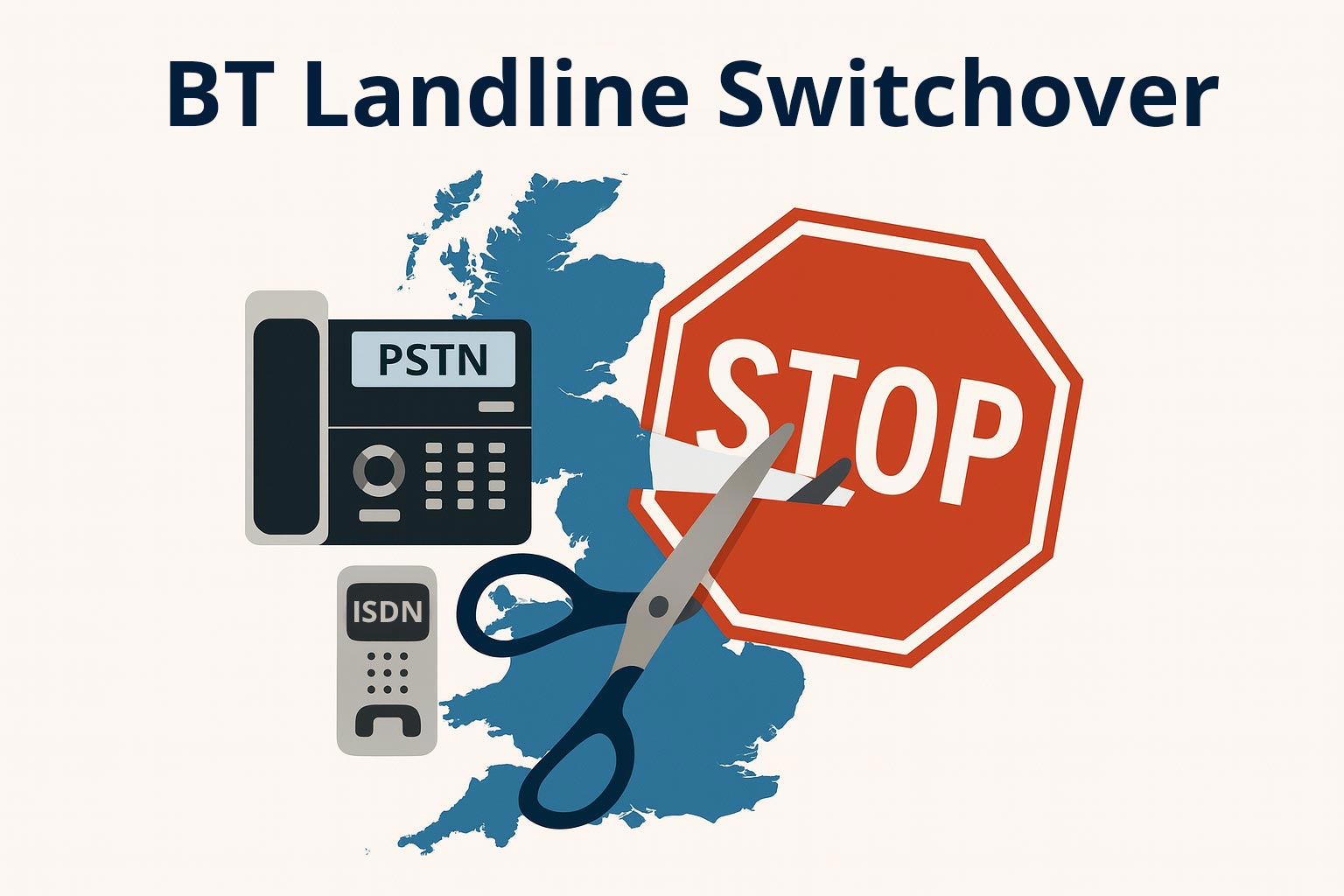
Navigating the 2027 PSTN Switch-off
The retirement of the Public Switched Telephone Network (PSTN) by Openreach poses a unique risk to healthcare providers.
Identifying Legacy Risks
Many practices are unaware that their legacy analog lines do more than just voice calls. They often support:
➡️ Plan Comparison: View a detailed breakdown of all our licensing tiers and features: VoIP Plans & Pricing
The Migration Roadmap
Fax Machines
Still utilized in some clinical pathways.
Lift Alarms & Panic Buttons
Critical for site safety.
Old PBX Hardware
Which will cease to function entirely post-switch-off.
Step 1
Audit
- Identify every analog line and its purpose.
Step 2
Connectivity Check
- Consult our Connectivity & QoS guide to ensure your broadband can support high-fidelity voice.
Step 3
Cloud Transition
- Move to a geo-redundant VoIP platform.
Step 4
Hardware Update
- Replace old handsets with modern IP-enabled devices or softphones.
Step 5
Staff Training
- Ensuring reception and clinical teams understand the new triage features.
Multi-Site PCN Overflow
In a real-world PCN environment, if one surgery is overwhelmed by an unexpected surge in calls, the system automatically overflows excess traffic to a sister site. This ensures no patient is left unanswered and maintains the practice’s reputation for accessibility.
Remote Triage & Telehealth
The rise of remote working for clinicians requires secure solutions. Our softphone applications allow GPs to conduct consultations from home using the practice's phone number. This maintains professional boundaries while ensuring all calls are recorded and logged within the secure practice environment, meeting all SLA and governance requirements.
Implementation and Real-World Scenarios
Trusted by UK GP Surgeries and PCNs
Real results from UK businesses who made the switch
1000+ UK businesses trust Stride | 5/5 average rating | 98% first-contact resolution
Healthcare Telephony FAQ
Is your call recording CQC compliant?
Yes. All recordings are encrypted and stored in UK-based data centres, meeting all GDPR and CQC audit requirements. We provide granular access controls for Caldicott Guardians and automated redaction for sensitive data.
Does the system work across multiple sites?
Absolutely. Whether you are a single GP surgery or a multi-site Primary Care Network (PCN), Stride provides a unified cloud-based interface
Can we keep our existing NHS numbers?
Yes, Stride Communications manages the full porting process for all existing local and non-geographic healthcare numbers.
Are VoIP calls secure enough for medical consultations?
Yes. Our systems use SRTP (Secure Real-time Transport Protocol) to encrypt voice data, ensuring that consultations are protected from interception, meeting all NHS and GDPR security standards.
How does the EMIS integration actually work?
The system uses a secure API or middleware to search your EMR database the moment a call hits the queue. By the time the call is routed to a handset, the patient’s name and DOB are already displayed.
What happens if our internet goes down?
Our healthcare systems feature automatic failover. If your local internet fails, calls can be instantly redirected to mobile apps or a secondary site, ensuring your clinical “front door” never closes.
How does this system integrate with EMIS Web?
The integration functions via a bi-directional API link. When an inbound call is detected, the system executes a real-time database lookup within EMIS. If a match is found, a “screen pop” displays the patient’s demographics and clinical summary on the user’s workstation. Additionally, clinicians can use click-to-dial functionality directly from the patient record to streamline outbound clinical consultations.
Is the voice data stored within the UK?
Yes. All voice data, including call metadata and media streams, is hosted within Tier-3 UK data centres. This ensures full adherence to compliance and security standards regarding data sovereignty, satisfying the requirements of the NHS Data Security and Protection Toolkit (DSPT).
Can we prioritise emergency calls during peak times?
Yes. Through intelligent patient triage configurations, the IVR can provide a dedicated “Option 1” for clinical emergencies. These calls are immediately routed to a priority ring group or a “hot phone,” bypassing standard administrative queues to ensure zero-latency access to clinical staff.
How does the system handle the 8am appointment rush?
The system manages the 8am rush by replacing “busy tones” with unlimited virtual queuing. Features such as “Position in Queue” announcements and automated call-back technology allow patients to hang up while retaining their place. This flattens the call volume curve and reduces the administrative burden on reception teams during peak demand.
What are the CQC requirements for call recording?
To maintain CQC compliance, practices must ensure that call recording is used to improve patient safety and staff training. Requirements include a clear privacy notice (audible greeting), secure storage with an audit trail, and the ability to redact sensitive information. Recordings must be easily retrievable for Subject Access Requests (SARs) or clinical governance reviews.
Future-Proofing Patient Communication
A healthcare-grade communication system is defined by its ability to provide uninterrupted service under pressure. By decentralizing your telephony into a geo-redundant cloud environment, you gain a disaster recovery solution that ensures patient access even in the event of local hardware failure. This transition reinforces the practice’s commitment to patient safety and operational excellence.
Ready to enhance your practice’s access? Contact our healthcare specialists today for a clinical efficiency audit and discover how a tailored healthcare business phone system can transform your patient pathways.
Teams User?
Seamlessly add external calling to your existing workspace with Teams integration.
Teams Calling →
Managed Software
Discover the power of our 3CX managed phone system for advanced call handling.
Discover 3CX →
Scaling Up?
Learn about our Cloud solutions for large-scale healthcare providers.
Cloud Solutions →
Evidence
Review our latest Case Studies to see how we help UK practices.
View Case Studies →